Claas unveils new Axion 9
13th November 2025
At an exclusive press event at its UK head office in Saxham at the end of October, Claas unveiled the latest generation of Axion 9 tractors ahead of the official launch at Agritechnica. Daniel Hodge reports.
While 2025 has tested most major manufacturers, Claas has managed to hold its ground.
Speaking at the UK preview, senior vice president Trevor Tyrell painted a mixed picture of the global market: combine sales at record lows and arable margins tightening sharply across much of Europe, yet Claas maintaining a steady turnover in the UK and Ireland. “Full speed ahead,” he said, summing up the company’s stance amid the downturn.
Trevor noted that tractor sales have more than compensated for the fall in combine numbers, with Ireland in particular showing a 25% uplift over the past year. Across the group, Claas has continued to invest heavily in production and R&D, expanding or modernising nearly every major site – from the forager plant in Harsewinkel and the baler factory in Metz, to a new €11 million extension at Le Mans, where all new Axion models will be built.
The company’s strategic focus is clear: growth through high-horsepower tractors and greater presence in global markets, especially North America, where Claas is developing its next generation of combines locally for the first time.
Despite wider market pressures, Trevor’s message was confident – Claas is betting on technology, investment and premium products to carry it through the cycle.
Design and identity
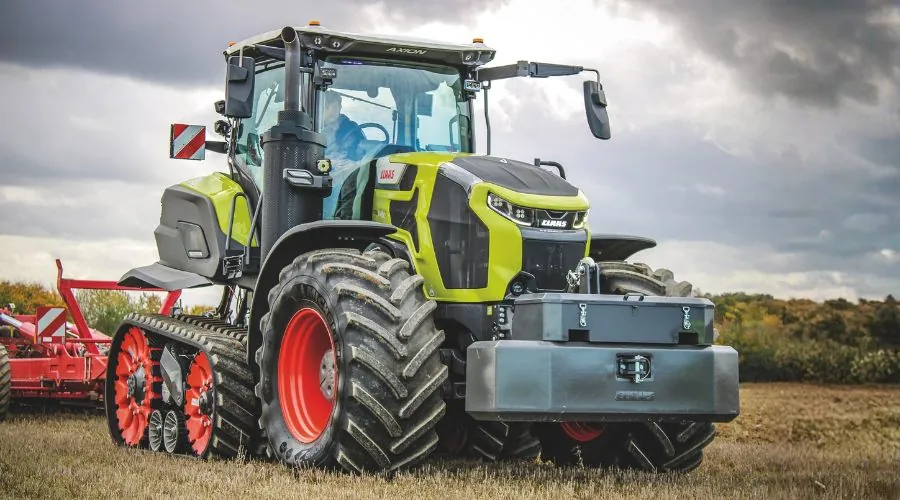
When the covers came off the new Axion 9, a genuine ripple of approval ran through the room. The familiar proportions are retained, but the face looking back at you is now sharper, leaner, and meaner.
Patrick Frawley, product manager for large tractors at Claas UK, described it as “turning customer expectations into reality” – a sentiment that echoed throughout the launch.
The new styling centres around what the company calls the ‘Claas visor’. It’s more than just a cosmetic flourish, it helps define the tractor’s identity, giving it the same visual authority as the company’s flagship foragers and combines.
Claas’ design team admitted that the tractors of old “didn’t excite”, and the new generation is their answer – a machine that is designed to look every bit as advanced as it performs.
Within, the transformation continues. The new K09 cab sets a new benchmark for space, comfort, and refinement, pairing high-grade materials with a subdued automotive colour palette. Every surface and control have been re-evaluated for function and feel, resulting in an environment that matches the expectations set by Claas’ premium image.
For a brand often praised for engineering over style, the Axion 9 shows that Claas can do both. It’s a tractor designed not only to deliver horsepower and productivity, but also to make it so that operators want to climb in and stay there.

Powertrain and driveline
Underneath the bold new styling, Claas has rebulit the Axion 9 from the ground up. Power comes from an 8.7-litre, six-cylinder engine, delivering between 317–448hp across the series, with the range-topping 9.450 Terra Trac at its peak.
Each unit employs a variable-geometry turbocharger and a fully adaptive driveline management system that continuously adjusts engine speed and transmission ratio for optimum efficiency.
A headline feature is ‘Auto Load Anticipation’, which is a predictive system that anticipates load changes before they happen. For example, when lowering an implement into work, engine speed will be raised proactively. This results in smoother transitions, fewer rev drops, and a more stable ride under heavy draft conditions.
Power delivery is handled by the latest ZF Cmatic CVT, which has been re-mapped with improved torque response, better low-speed control, and a new automatic stretch brake for greater downhill stability.
At the rear, the new half-track Terra Trac system retains its key advantage: the ability to deliver more than 50% greater contact area than a wheeled equivalent, without the pitching and pressure peaks associated with triangular track systems.
Maintenance has been simplified too, with all service intervals extended to 750 hours, and transparent mid-roller and idler caps for quick checks. Overall, this results in less down-time, and Claas claims an 18% reduction in service costs compared with the outgoing Axion 900.
It seems that this might have been where the biggest gains have been made. The new driveline and track unit promise not only more efficient power transfer, but also lower wear, easier servicing, and better fuel economy – traits that matter more than ever in today’s incredibly cost-sensitive market.
Cab and operator environment
Claas describes the new K09 cab as “a completely new generation”, and in this case, that doesn’t seem like an exaggeration. The overhaul is total – from the frame and glasswork to the controls, ergonomics, and the materials. The cab is 17% larger than before, offering a class-leading 3.24m3 of internal volume, and yet manages to be the quietest in its bracket, registering just 66dB at operating speed.
The improvements start before you even climb aboard. A redesigned stairway with aluminium die-cast steps and a shallower angle make access easier, helped by new lighting and handrails. Inside, the space feels immediately more premium.
The seat rotates 40-degrees to the right and 10-degrees to the left, allowing operators to comfortably get a full view around them without contorting themselves. Claas has delivered the sort of environment that makes a long working day feel much more bearable.
Air-conditioning performance is up 30%, thanks to new dual fans, while 360-degree LED lighting packages offer up to 48,000 lumens for night work. Storage, visibility, and finishing quality all take a clear step up, with a 10% larger glazed area and the widest rear window opening on the market.
The new CEBIS Connect terminal integrates all key functions from GPS guidance and CEMOS optimisation to lighting, hydraulics and multimedia into a single 12in touchscreen, with the option of a second display. The redesigned armrest and ElectroPilot joystick provide up to 38 assignable controls, giving operators near-total customisation.

Hydraulics and implement control
Matching the power on tap is a new high-capacity hydraulic system that gives the Axion 9 series the muscle to handle today’s largest implements with ease.
Operators can specify either a single-pump setup delivering 220-litres/min, or a twin-pump configuration producing up to 370-litres/min, with two valves capable of supplying 170-litres/min each. The dual-pump system allows simultaneous operation of high-demand implements, a clear nod to the needs of modern contractors and large-scale arable farms.
A redesigned rear linkage delivers up to 12t of lift capacity, while the front linkage retains a robust 6.5t. Claas has added a hydraulic top-link assist, allowing the heavy top link to be raised or lowered effortlessly via a pneumatic cylinder. It’s a small but much appreciated touch for anyone who’s tried to manhandle one.
Further refinements include new hydraulic stabilisers, auto trailer axle locking, and an upgraded front axle capable of carrying greater ballast, giving the tractor more flexibility for heavy front-mounted implements. The Terra Trac version, meanwhile, continues to offer class-leading traction and soil protection for those who value low ground pressure.
Digital intelligence and autonomy
The Axion 9 introduces an entirely new electrical and electronic architecture, designed from the ground up to handle the growing demands of automation, connectivity and data management. Every control unit, fuse and wiring harness has been re-engineered, creating a platform that Claas says is “future-proofed for the world of autonomy”.
At its heart is the CEBIS Connect terminal – a unified interface that brings together GPS steering, implement control, headland sequences, lighting and multimedia. The new system integrates directly with Claas Connect, the cloud-based portal that enables data sharing, remote monitoring and machine documentation.
For the operator, that means real-time access to performance data, task planning and remote support through their dealer. For managers, it opens the door to detailed job reporting, variable-rate applications and emissions tracking across the fleet.
The new tractors also support the latest AEF Isobus compatibility, allowing seamless connection with mixed-fleet implements and data exchange through the growing universal ag-data network. Claas’ own automatic documentation feature now records inputs and emissions per field and even generates contractor-ready digital reports at the end of each job.
Perhaps the most forward-looking element unveiled at Saxham was Claas’ first step towards Level 2 autonomy, developed in collaboration with Dutch partner AgXeed.
The system uses the AgXeed VCU module to execute pre-planned field tasks autonomously under operator supervision. Routes, headlands and working parameters are created in the office via Claas Connect, sent wirelessly to the tractor, and executed in the field with the operator present in the cab. Steering, hitch position and hydraulic control can all be automated, but the driver retains ultimate responsibility.

UK relevance and outlook
For British and Irish farmers, the Axion 9’s upgrades go far beyond aesthetics. Claas’ high-horsepower tractors have carved a loyal following in the contracting and large-scale arable sectors, and this new generation clearly targets the realities of those businesses: tighter margins, longer working days and increasing pressure to do more with fewer people.
Extended 750-hour service intervals and lower overall maintenance costs will appeal to operators chasing uptime and predictability. The integration of remote diagnostics and dealer-linked service notifications through Claas Connect should reduce unplanned downtime, a small but critical advantage during short drilling or harvest windows.
Equally relevant is the shift toward digital compatibility. Many UK farms now run mixed fleets, and Claas’ open-data approach through the AEF Isobus framework ensures that the new Axion can work alongside other brands without friction.
From section control on drills to automatic documentation for fertiliser applications, the system reflects how professional farming is evolving: increasingly data-driven, collaborative and accountable.
In a market where return on investment matters more than ever, the new Axion 9 is pitched as a long-term workhorse with modern sensibilities. Its arrival also highlights Claas’ commitment to manufacturing and support, with all models built at the upgraded Le Mans plant and backed by a strengthened UK dealer network.
For operators and managers alike, it’s a clear signal that Claas intends to compete not just on engineering reliability, but on whole-farm efficiency.
A statement of intent
The Axion 9 is more than a facelift for a proven platform. Claas has taken the lessons of a decade in the high-horsepower market and rebuilt its flagship from the inside out, blending the comfort and digital sophistication of a premium tractor with the durability expected of a true workhorse.
It arrives at a time when efficiency, reliability and operator appeal matter more than ever. From the re-engineered driveline and longer service intervals to the revamped cab and connected electronics, every detail points to a machine designed to work harder for longer, and to keep its driver happier while doing so.
As Claas prepares for the public debut at Agritechnica, one line from the launch presentation resonates: expectations become reality. For the Axion 9, that feels about right, though what those expectations will cost remains, at the time of writing, undisclosed.
Read more machinery news.
